

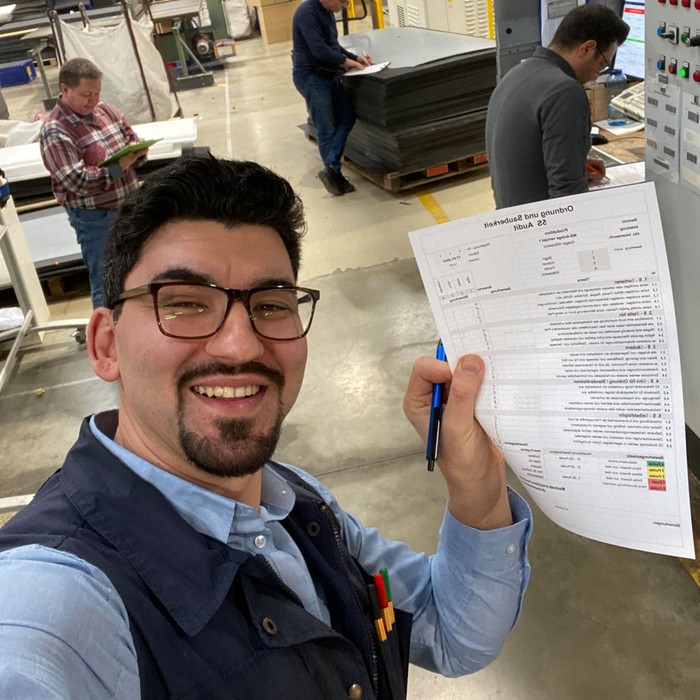
Efficiency, continuity, improvement—if you want to sum up lean management, these three words are essential. Tuncer Bilgin (pictured here with those responsible during the internal 5S audit) has been Senior Lean Manager at Leidel & Kracht since November 2018 and has already implemented several measures for the foam manufacturer during this time.
Mr. Bilgin, you have been working for Leidel & Kracht as a senior Lean Manager since 2018 and, as a Lean expert, you understand your subject very well. So please forgive me for asking such a basic question at the outset: What is Lean Management and why is it important?
Generally speaking, lean management is a method for continuously optimizing a company's processes, in which all employees work together to achieve common goals and meet customer needs. This starts at the very top of the business processes and involves all departments – right down to shipping. To do this, a continuous improvement process (CIP) is used, in which employees' problems are recorded every day. These are then solved with the help of various other measures such as Kaizen, shop floor management, and the 5S method.
But why is lean management important? It allows me to reduce inefficiencies in processes. An example would be all types of waste in the company, such as time resources or material resources. This improves the quality of the finished product, which in turn leads to increased customer satisfaction.
What is the 5S method?
Seiri (sorting/selecting), seiton (organizing/systematizing), seiketsu (cleaning), seiso (standardizing/tidying up), and shitsuke (self-discipline/discipline). These are the Japanese terms for the basic principles of lean management. So I sort, organize, and clean, which automatically gives me security. Since this is often misunderstood: cleaning in this case does not mean cleaning! I clean the process. I ask myself, what do I need? Which tools, pallets, and containers? What do I always need to have at hand? Next, I systematize. In this step, I can create a shadow board, for example. If I say that I only need three types of tools for this small machine, I may combine these three into one by creating a new tool. This allows me to create a structure from the system, which automatically gives employees more security. Because they know: This tool belongs there, they can use it to fix the problem, and it's listed on their work card. On the other hand, they also know that if it is missing, they have to look for it. In lean management, you also gain certainty by marking the floor. Or by labeling the system to indicate where only good parts are stored and where parts that are questionable are stored. The fifth S, shitsuke or discipline, means that processes must be constantly questioned and improved. So, in the continuous improvement process, you ask yourself: Are we still working according to the 5 S's? Do we have a standard process as a self-sufficient system? Do we have appropriate rules? Or have we discarded everything because it was not implemented sustainably?
What specific measures have you been able to implement at Leidel & Kracht since 2018?
Quite a few, because we have "lean-ized" an entire plant, so to speak. We have structured it in line with lean principles and implemented every conceivable process. If you walk into the plant now, you will see that everything is labeled: We have floor markings and signs that tell employees "You can put something here" or "Not here." "Only good parts belong here" and "The bad parts are here." Of course, you will also find shadow boards at every corner at Leidel & Kracht. These are simply useful so that employees know exactly which tools belong where without any problems or long searches. The shadow boards also show that the tools grouped together in them belong to the respective machine for problem solving. Since Leidel & Kracht manufactures the multi-colored foam inserts for customers anyway, it was only logical for us to make extensive use of them ourselves. Shadow boards are simply indispensable for a lean process.
To give an example of a very successful project, I'll go back to my early days at Leidel & Kracht. The prototype construction department asked me for an idea so that they wouldn't always have to chase after the prototypes. By assessing the current situation, I discovered that we had no transparency in prototype construction, the prototypes were virtually invisible in production, and customers were therefore receiving them too late. Employees always had to go through four departments to find out the status: Sales contacted prototype construction, prototype construction then contacted production, the production manager contacted the foreman, and the foreman then went to the machine to see what was happening with the prototype. On the one hand, this was very inefficient and, on the other hand, it was naturally also annoying, because every sample is a potential customer order and if the customer receives the sample much too late, they may reconsider. That's why the whole process now takes just one click. This means that I click on the status of the sample on my computer and can immediately see how the development is progressing. So we have created more transparency here. Employees now know immediately what the status of the sample is and can identify any problems at an early stage. As a result, we no longer have any delays with samples, which is a long-term success.
I gather that you have also digitized a lot?
Exactly, we have also focused heavily on digitization in our plants. Another example from prototype construction: Here, employees who had to approve customer samples always had to run to the respective departments with their components and then find the right contact person there. We reversed this process: while the employee works efficiently on the plant, they click a button and the department is informed. Then the necessary qualified employee arrives, who in turn talks to someone who is trained on the plant. In lean management, this is called genchi genbutsu, which translates as "go to the place where it happens." The responsible employees from the departments go out to the machines and take a look at what is happening. To this end, we have developed level cards and qualification matrices. And our shop floor with the Kanban board and the CIP has, of course, also gone digital.
How does that translate into figures?
The measures implemented in the plant have proven very successful for us. The plant arrived in 2019, and we immediately looked at all the conditions and checked how we could integrate this machine into lean management. After a shutdown of the plant, we now have an effective availability of over 70%. More precisely, 73%. That's great, but it also shows how much potential this machine still has in the next step.
We've talked a lot about the advantages. Are there any disadvantages to lean management?
I would like to say "no," but of course there are disadvantages. It is not always easy to implement lean management in a company. You have to be very careful not to move too fast. If I go to the employees, hand them cell phones and tablets, and say, "You have to click here and now click there," then I'm taking them out of their comfort zone too quickly and perhaps overwhelming them. This then manifests itself in them making unfortunate mistakes, producing poorer quality parts, or slowing down. And then their supervisor stops them because they notice that their people aren't keeping up. Supervisors are very important anyway, because only when I can convince them of what we are trying to achieve as the Lean Management department will we get the resources we need. This requires a great deal of tact, because the departments may be measured by their sales, and these will initially decline when we come in as the Lean Management department because we take up resources. We need the employees, hold small workshops with them, and then implement Kaizen weeks. That's why lean management always has a lot to do with trust.
What are your go-to lean management measures? Where is the best place to start?
The best place to start is by stirring things up in the department by repeatedly asking "why." Don't stop at the first "why," but keep digging and be persistent. Here's a simple example from our production department: There were always brooms missing. So I went over and asked, "Why are the brooms missing?" "The other department has them." "Why does the other department have them?" "No idea." So I went to the other department and asked "why" again. "Because I don't have one myself, because mine disappeared." "Why did yours disappear?" "Because it probably wasn't put back in its proper place."" "Why not?" "Because everyone puts it somewhere else." "What could be done to prevent this situation from happening again?" "Assign a specific place and make shadow boards for it." Problem solved.
Since we've had the shadow boards, nothing is missing in the department where we introduced 5S. Of course, there was chaos at the beginning, despite the shadow boards. But that's no longer the case because we took it seriously and didn't just say, "It's only a broom," but rather, "It hinders the process and causes delays." Now there are responsibilities behind it: someone is responsible for the department and checks that everything is in its place at the start of the shift. That's why shadow boards are one of my favorite gadgets. Just like the Kanban boards as an agile method on our shop floor. These hold the digital Kanban tickets, which are moved when tasks are completed or if there are any queries, and the department manager can see immediately what problems there are in the department. Before we had the Kanban boards, maintenance always reported dirty machines. They couldn't start maintenance because problems had to be fixed first. We turned this into a little lean game: We posted the four most common problem images from maintenance and said these are no-gos. Now, when one of them occurs, maintenance writes a ticket for the department manager, who then has the opportunity to fix the problem while the machine is down. This works great, and the machines are always in top condition after the last shift of the week. As a result, they now have less downtime and are available for production much more often.
Who would you recommend lean management to? Are the methods practical for everyone?
Personally, I think lean management is very important in companies that want to remain competitive. Those that need to adapt to market conditions, but also want to do so. This ranges from large companies to medium-sized and small businesses. In fact, lean management is also really practical on a very small scale. For example, in your own home! My wife and I have even organized our pantry using the 5S method. We labeled the shelves: The things that are "sold" the most, i.e., used by us, go on one shelf. The ones that aren't used very often go on the top shelf. To be honest, my wife wasn't too keen on the idea at first, but I was able to convince her, and now she's actually enthusiastic about it! As part of our continuous improvement process, we also connected an app: as soon as I take something out and notice that the product is running low, I immediately swipe it into the shopping list in the app and no longer have to write a shopping list for the weekly shop. This saves a step and time, and also makes our own processes more efficient.
Thank you very much for the interview and continued success!
Are you interested in embarking on the Lean Management adventure with your own customized shadow board? Contact us!


